

Finding
I want to preface this follow-up to my Somewhere Between post by highlighting three articles I read while researching finding ads. One: Cut Off from Our Past. Two: Connecting Chinese Adoptees to Birth Families. Three: End of an Era. I will reference some of the facts and topics these authors address, but I highly suggest reading these resources as context before or after you read part two below.
The word ‘finding’ suggests that something is first lost, or hidden. Lost, think about that word and how you may use it in your day-to-day life. The range of lost-ness can be vast. Situations such as “Oh, I lost my keys!” or “Why do we keep losing the t.v. remote?”; these are generally benign uses for the term lost. However, lost pets, lost hikers, cold case missing persons; these are applications for the word lost that escalate in seriousness. The more precious the thing that is lost, the more value we assign to its finding. We even use the word lost as a euphemism to talk around death (which can be confusing because trying to use lost in this context is like trying to move down the scale, closer to a softer meaning of the word, while describing a circumstance on the other end of the scale— one that can be extremely tough or tragic).
Following the thoughts above, if someone uses the word ‘find’ to describe how they ‘found’ a child, perhaps you would conclude that the child was probably…lost. However, is it possible to be found, but never lost in the first place?
For many adoptees from China, this is often the case.
It is hard to reconcile the fact that many adoptees from China— we were “found”, but to use the word lost to describe how we ended up being found would be misleading. Frankly, ‘relinquished’, ‘surrendered’, ‘stolen’ -these are some of the words that more accurately describe the situation of many children who ended up in welfare institutes under China’s one-child policy.
“China began its international adoption program in 1991, and adoptive families were told that the children being adopted had been abandoned at orphanages, at schools and on the streets. An estimated 110,000 children from China have been adopted globally through the program, the majority of whom are in the United States. From 1999 to 2018, American families adopted about 81,600 children from China, according to the State Department (Constante, Agnes [2]).”
From 1999 until presumably fall 2024, Chinese welfare institutes (orphanages) were legally required to publish ‘finding ads’ in their provincial newspapers, describing “where and when each child was found and which orphanage is caring for them. Originally these were text-only ads, but most provinces later included photographs—photographs that are usually the earliest available pictures of the children, some at just days or weeks old (Stuy, Brian [3]).” For adoptees searching for information about their history and family, recovering their original finding ad can become a useful tool. However, having a finding ad can also be a dead end, because many finding ads may contain false information.
I, myself, was not aware of the existence of finding ads until one of my friends (also an adoptee from China) brought it up. As an adoptee who is curious about learning more about my history and maybe even one day connecting with a blood relative, I thought, “this information is intriguing”, and stored it away to unpack at a later time. Every handful of months (maybe once a quarter?) I circle back around to see if I can make any headway in figuring out more about my history, whether through checking 23andMe (although I’ve deleted my account due to data concerns. That's another story), GEDMatch, Chinese websites that are hard to use since I don’t know Mandarin, etc. It wasn’t until this past spring that I remembered finding ads was a lead that I wanted to follow.
Through Brian Stuy and his family's organization Research-China plus their efforts to collect and digitize finding ads, I was able to submit a request to find, ironically, my finding ad.
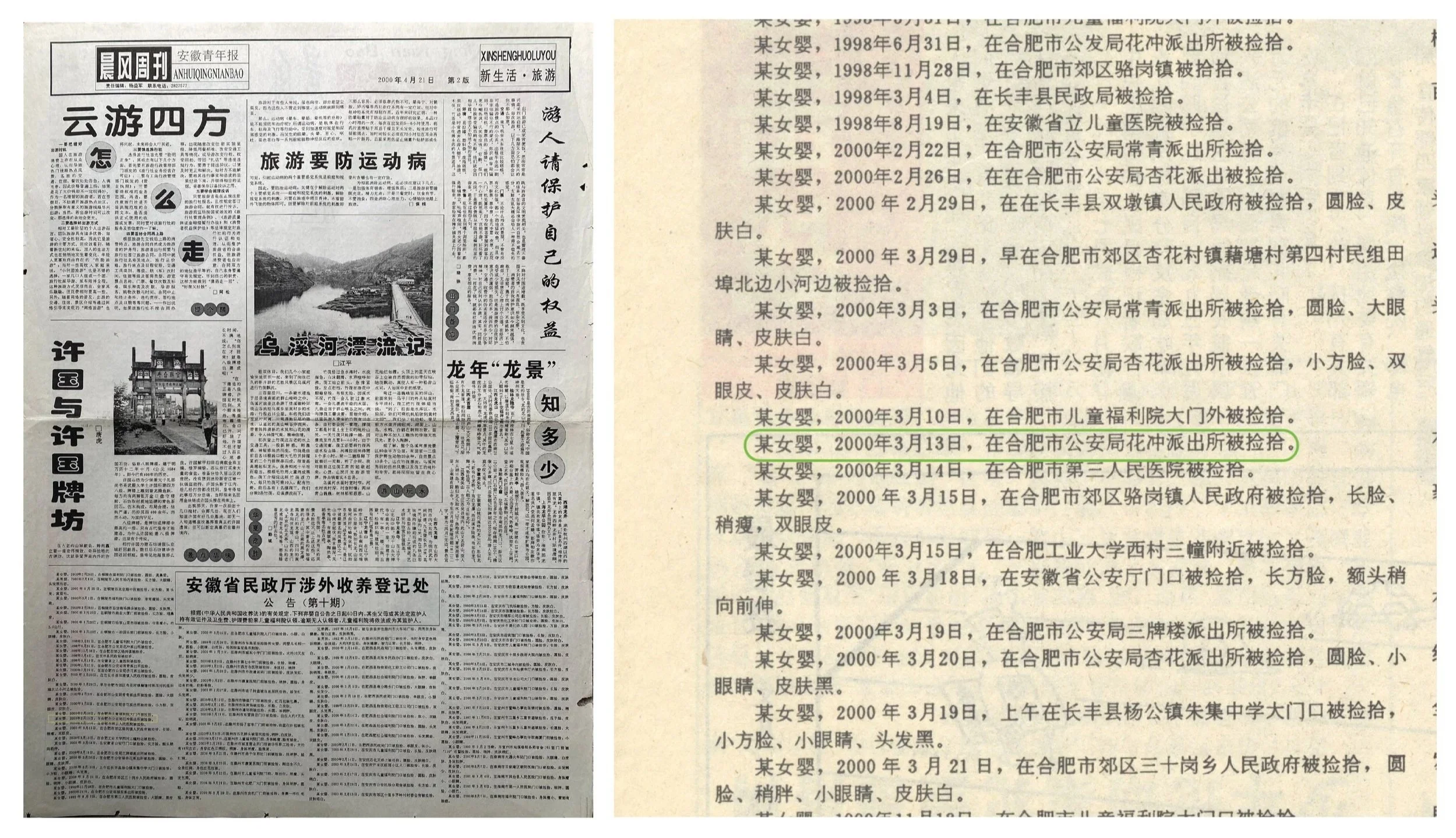
Digital scans of my finding ad. The bottom section of the paper contains entries of info on ‘found’ children.
Now, I have my finding ad, but I am still left in the same place of unknowing. In some sense, it is nice to know I have one more small piece of my history that I didn’t have before. I can see where my information was listed in the paper that day. I can “read” it in the original Mandarin (with the help of Google Translate). I can also see all the other children listed in that paper; there are so many. In other senses, it is frustrating, because it doesn’t put me much closer to more complex discoveries such as: do I have any other adopted siblings, what about unadopted siblings, who are my birth parents?
However, despite this strange ‘knowing more while knowing nothing at all’ limbo, I do have more general knowledge that I can take away and apply going forward. I have tools and resources to encourage adoptees to learn about finding ads. I have more facts and words to share about the repercussions of China’s one-child policy. I have more awareness to remind people that the rhetoric of Chinese adoptees being “abandoned babies” is often not true.
One last fact that I want to leave you all with is that, if you didn’t already know, since the fall of 2024 foreign/international adoptions from China are no longer possible [4]. The thought that this could ever happen… never crossed my mind until I stumbled upon a news article sometime in that fall of 2024. And it always felt strange to me that it happened so quietly. No one in the general public really seemed to be talking about it; it didn’t become extremely major news. A system that was (and is) such a big part of my story was seemingly suddenly dismantled. And it is not just me who found this news strange to contemplate; this has affected many Chinese adoptees as they heard the news and began to process how this touches their lives. Some very poignant and emotionally tough thoughts are shared by fellow adoptees in an article by Nanchang Project [4].
As always, if you have any thoughts and questions regarding the topics I introduced, I would love to dig into them together. I hope that through this follow-up, you perhaps gained new knowledge plus empathy for the complexity of international adoption and how it affects adoptees.
With Love,
Mia