

He Chun’ai, Somewhere Between
Growing up Asian American in a (for the most part) standard, suburban, middle-class White American family didn't feel very strange or different. Knowing that I am adopted did not particularly distress me. In my circle of familial community, the concept of adoption is familiar. Not only is one of my sisters an adoptee, but I also have three adopted cousins.
But familiarity does not equal simplicity. Growing up as an adoptee adds complexity to the meaning and experience of developing self-identity. My experience, my “in between”—this is only one experience. I cannot speak for all adoptees. Furthermore, my experience will never reach a peak of being fully defined because it is constantly redefined over and over through time as I live each day God has set out for me.
In the bubble of my elementary years, I was simply "me" (in the broadest of stereotypes), a culturally White American, Asian in appearance, girl who lived without much thought on these concepts. And even as these concepts became more real to me when my middle-school self felt the desire to look “less Asian” (read: White), I seldom wanted to dwell extensively on being adopted. Now, I am still very much an Asian looking girl shaped by a culturally White American childhood. However, with much developed self-awareness, introspection, more diverse experiences, poignant conversations —being me grew to include more pride for my Asian heritage (culturally & physically), a good bit less adolescent angst, and more willingness to explore what being adopted means to me.
Somewhere Between is a title I am borrowing from a documentary following the lives of four teenage girls adopted from China and now living in the United States (1) because I feel like it best describes the imperfect middle ground that many transcultural adoptees (and immigrants) experience.
Even with my growth in self-identity, being an adoptee isn't something that I constantly think about, but the fact is I've had, and will have, many moments that make it an undeniable part of who I am. Moments when I am suddenly aware that I am feeling either “Not Asian Enough” in predominantly Asian spaces or “Too Asian” in majority White contexts. Sometimes, these experiences are misunderstandings that are universally funny, funny to my family, or funny to my sister and me after the fact. Other times, they are personally painful— mean, pointed, and demeaning experiences. Sometimes these moments are the joys and sadness of simply relating to another adoptee or person of color through the news, books, films, and social media.
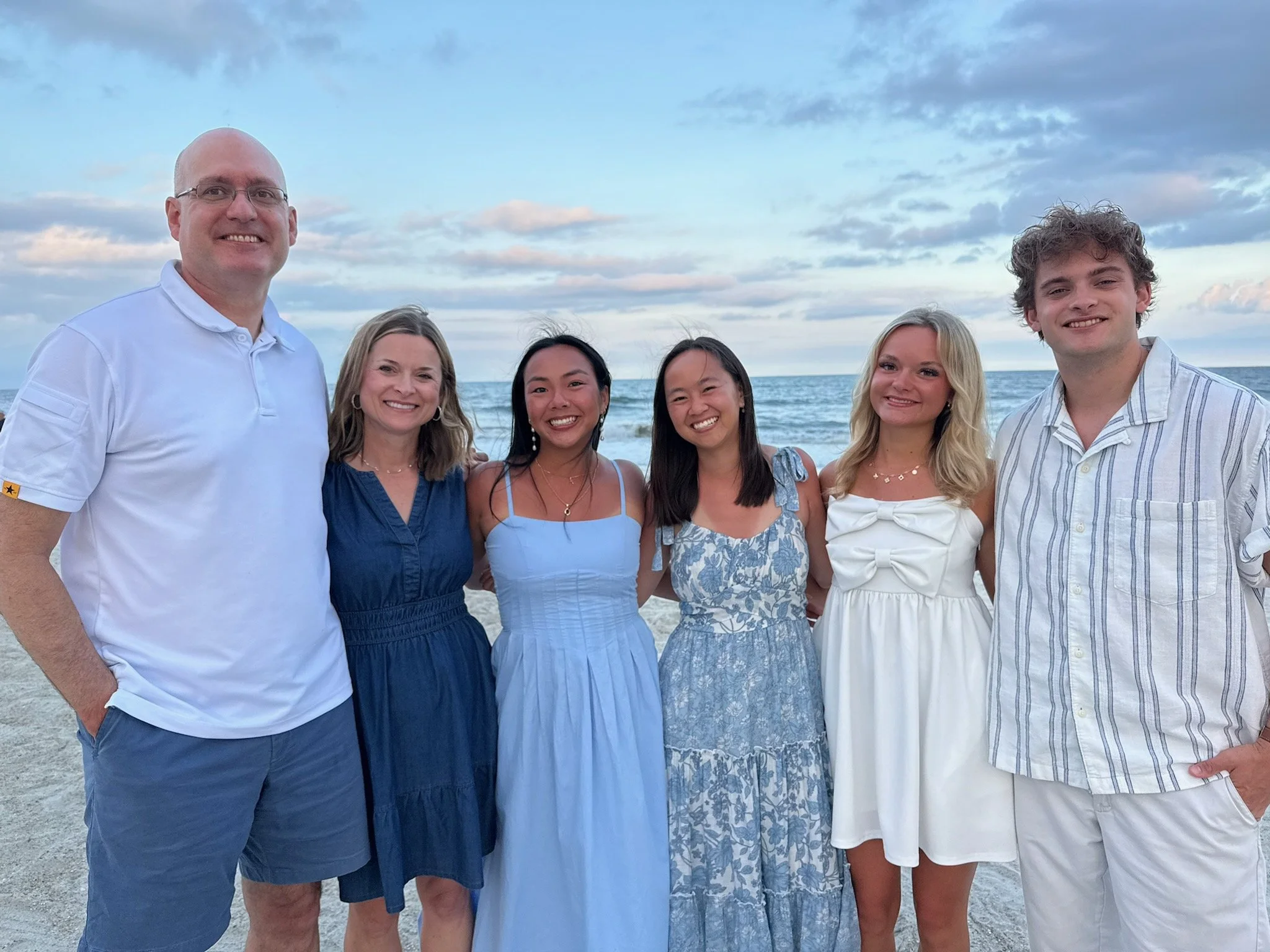
My family! | Hilton Head SC, 2026
And every so often, it is through moments of sudden self-reflection that I am struck with the fact that not everyone can call themselves an adoptee. Yes, on a spiritual level, the Gospel describes our new life in Christ as adoption:
Galatians 4:4-6
“4 But when the fullness of time had come, God sent forth his Son, born of woman, born under the law, 5 to redeem those who were under the law, so that we might receive adoption as sons. 6 And because you are sons, God has sent the Spirit of his Son into our hearts, crying, “Abba! Father!”
But globally, on a biological, anthropological level, only about 260,000 children are adopted annually, with classifications including domestic and international adoptions (2).
Admittedly, it is sometimes nice to have a unique panic-answer solution during ice breakers when the question is “what is one cool fact about you?” But deep down I know now that, for myself, answering “I am adopted” is not “just a fun fact”. Being adopted is an essential part of who I am.
Furthermore, as I have continued to grow in my self-identity and my faith, I find that a conversation I had with my RUF girls intern in college still holds. She asked if I felt that being adopted is something I find important for others to know about me. I thought about it and told her that, yes, for someone to understand me and my story fully, I believe that includes knowing that I am an adoptee. Knowing that I believe this aspect of my life is important to share with others is both encouraging and daunting. It is encouraging because I have come a long way in embracing all the positives and negatives that come with adoption. It is daunting because it requires being vulnerable.
In many ways, it is the same with sharing the Gospel and what God is doing in my life. I would be remiss to believe that someone truly knows me if they do not also know what gives me hope in this life. But sharing this truth requires a lot of vulnerability, humility, and trust. I frequently doubt that I can share my faith well, even though it is such a monumental part of who I am in Christ, and this self-constructed hesitancy is a barrier that I should and will be bringing to God in prayer and with conversations.
In conclusion, this is part one, and there will be a follow-up post detailing some new adoption artifacts that I received from Research-China (3). Originally, this post was going to be about the Finding Ad info I obtained. However, it morphed into a longer, different exploration into the topic of adoption, which has many, many more branches. Additionally, I would love to hear about how you share your stories with others and what this looks like in light of sharing the hope of the Gospel! If anyone is interested in writing a guest post in response, be sure to let me know.
情意,
Mia
FOOTNOTES
I have not watched this yet, as I suspect it will be a very emotional undertaking that I am not quite ready to digest. Link to documentary site.